
The 3 Disco Ball Types (by the facets)

If you thought there was only one type of disco ball, think again.
You may have heard glitter ball, mirror ball, or even myriad reflector as other words for a disco ball. Here, James introduces a brief disco ball lexicon that reimagines these synonyms to be non-synonymous. Instead, we use them to categorize disco balls by their facet sizes and quantity.

While people generally call the mirror-covered ball a "disco ball", it has gone by some different names throughout its time. The most OG name for it is myriad reflector, as this was the name under which the disco ball was patented in 1917.
Today almost nobody (except nerds like me) use myriad reflector to describe a disco ball. However, we do use it here to describe any disco ball with over 10,000 facets due to the Ancient Greek etymology of myriad coming from myrias (10,000). Originally it was the largest named number for the Ancient Greeks, also used figuratively to mean "too large to count".
The number of facets only tells us the number of reflections, not the size of reflections. The other two types of disco balls have been assigned their names based on facet size which is directly correlated with reflection size. The lighting effect is affected by the size of the facets on the ball(s) you decide to hang over your dance floor.
Mirror Balls vs. Glitter Balls
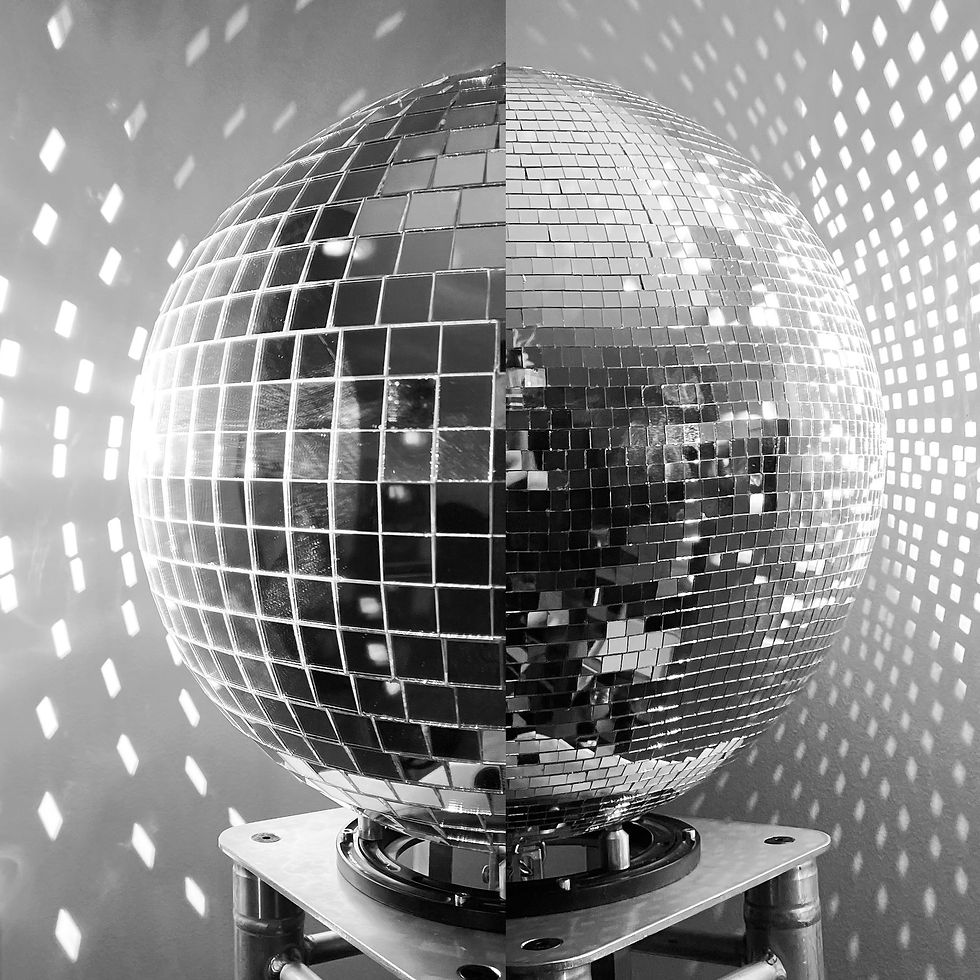
While we use disco ball as a catch-all term, mirror balls are known as disco balls with facets 1 square inch (1 inch X 1 inch) of area or bigger whereas glitter balls are known as disco balls with facets .25 square inches or smaller (.5 inch X .5 inch).
Any ball with its facet size between .25 square inches and 1 square inch doesn't land in either category and is simply a disco ball. As mentioned before, these things are kind of like squares and rectangles. Every glitter ball and mirror ball is a disco ball but not every disco ball is a mirror or glitter ball.

Likewise, a myriad reflector can have any size of facets on it. This specification is based on overall number of facets, not on facet size.
Our 40" myriad reflector is a glitter ball. However, you could also have a mirror ball myriad reflector, it would just need to be bigger to fit all those tiles (at least 60" wide to fit 10,000 square inch facets on it.)
While all of these facts about facets are fine and dandy, you're probably wondering: why does facet size matter?
Unlit Appeal vs. Lit Appeal

While the lighting effects will be affected by the type of disco ball you choose, it's important to consider its "unlit appeal" as well.
The mirror ball's facets are so large that you will feel as if you can see your whole face in one tile. These balls are also made with higher craftsmen-ship and you will notice an orderly section of four perfectly in-line rows on the equator of the ball. These mirror balls are made by Omega Mirror Products and Yolanda Baker in the USA and were the style used in Studio 54.
They have a certain disco luxe appeal, sacrificing quantity for quality.

A glitter ball creates many more reflections than a mirror ball, and for that reason alone it may be the style you want over your dance floor.
Glitter balls are fun to look at in their own right, as they have seemingly innumerable facets. This also make the reflections more consistent and yet less vivid, truly more "glittery" or "sparkly" in effect.
People tend to be more familiar with glitter balls and are less likely to have seen a mirror ball in person. But it's unlikely they've danced under a myriad reflector glitter ball..
Ultimately, the style of the ball is your choice. It really just depends on how much you value the different aspects of the aesthetics of each ball type.
Comments